Why Should I Choose Your Hotel?
Hospitality is getting increasingly challenging. In Northern Ireland, room capacity is increasing, and international brands now account for 47% of hotel rooms. More branded operators are entering the market, giving customers more choice across the entire range. And booking platforms have made comparison brutally easy.
From the customer’s perspective, that’s great. But it creates another problem. If twenty hotels are broadly similar in location, quality, reviews, and price, how do they actually choose one?
A quick brand language trend search across 100 hotels in our database reveals that 8 out of 10 repeatedly advertise with variations of comfort, warm welcome, good food, and the “ideal base” to explore from. This is a form of isomorphism: a category gradually converging around the same ideas.
Once most of the category is similar, there is very little for customers to anchor preference on. Price, reviews, and convenience become disproportionately important because they are easy to compare.
Branding obviously isn’t the only part of hotel choice. Location, service, facilities, reviews, price, and the actual quality of the operation all matter. For the purpose of this post, I’m looking specifically at the bit we spend our time thinking about:
What makes one hotel more desirable than another when much of the functional offer is comparable.
That’s where hotel branding can give customers a better reason to choose you. And when I say branding, I don’t mean getting a new logo. Branding, in this context, involves the entire hotel experience.
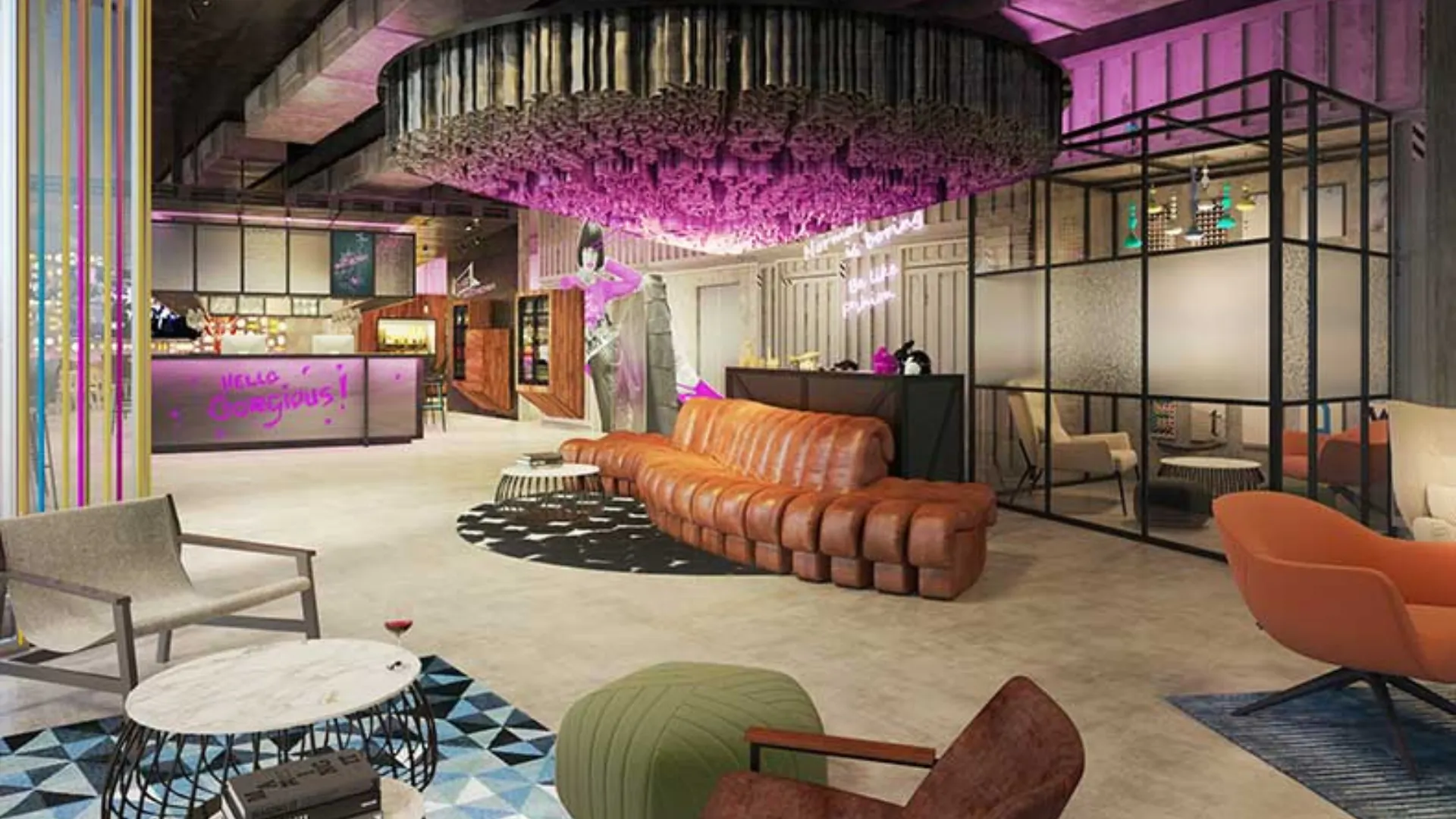
Here’s an example: Moxy hotels showed that you don’t need to offer luxury to create desire and preference. Their concept is relatively simple. They’ve taken an affordable hotel proposition and made the entire experience deliberate and recognisable for the type of person who wants a playful, stylish, affordable, and highly sociable stay.
That gives people something else to choose on besides whether it’s £4 more or less than the next option.
Another example is Hilton’s Tapestry. They give their hotels an opportunity to display more of their individuality and distinctiveness. Hilton itself describes Tapestry as independent hotels with individual stories, design, and food & beverage, combined with Hilton reliability and Honors. And owners keep buying into that proposition. As of June 2026, Tapestry had passed 200 open hotels, with almost 150 more in development.
That doesn’t prove that Tapestry hotels are performing brilliantly because of branding. But it shows that Hilton itself has recognised that familiarity and consistency are not always enough. There is value in allowing hotels to remain distinctive. Now add that Hilton have their Curio (“Remarkably Unique Hotel Stays”) and Outset (“Soulful, Surprising Indie Hotels”) collections, and you can see a definite trend.
Hotel chains spent decades creating standardisation. Now some of the biggest chains in the world are creating new brands specifically to put some individuality back into the hotel experience.
At the budget end, a distinctive brand might make a customer choose your £52 room over the £49 one.
In the middle, the gap between basic accommodation and your price is larger. That means the hotel needs a stronger reason to justify that difference.
At the luxury level, expectations, complexity, and potential value increase substantially. The entire experience starts contributing to the brand, and vice versa. And small incoherences in branding are much more noticeable. Everything has to keep supporting the expectation created by the brand and the price.
Back to the question: Why should I choose your hotel?
If your answer is a list of adjectives, you might want to reconsider what your brand stands for.